Sony Are Weaponizing Your Games To Exploit AI
Video Duration: 00:11:29Video Author: Bellular News
Understanding videos in seconds with WayinVideo
- #1 Fast AI video tool to analyze and summarize long videos.
- Generate transcripts, subtitles, and translations in 100+ languages.
- Find key moments, ask questions, and uncover insights instantly.
Overview
Timeline
Sony's AI gaming patent
- 00:00:00
Sony is developing an AI that can take over and play video games for users who are stuck or unable to progress.
- 00:00:17
The company aims to remove the need for friends or family to help with difficult game sections by offering an AI solution.
- 00:00:34
This generative AI is designed to be capable of playing games more proficiently than the human player.
- 00:00:46
The patent suggests a future where players can purchase a game and then have their PlayStation console play it for them.
The "Ghost Player"
- 00:01:11
Sony filed a patent in September 2024, based on a 2023 idea, for a proposed accessibility feature for PlayStation systems, which is currently undergoing international checks by WIPO.
- 00:01:45
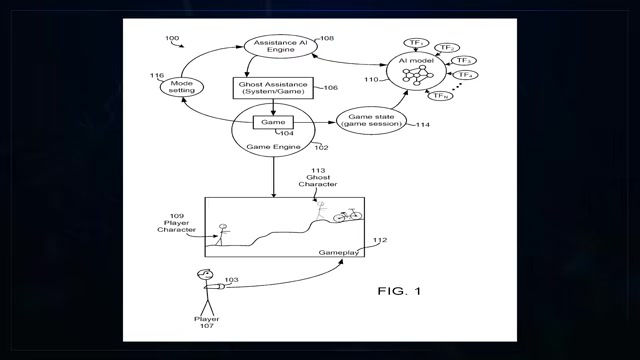
The patent describes an AI-generated 'ghost player' that offers two modes: a guide mode that shows a path through a level, and a complete mode that finishes the sequence without player input.
- 00:02:19
The primary purpose of this AI feature is to assist players who are physically incapable of managing game input, allowing them to skip difficult sections.
- 00:02:34
The concept of an AI-driven game assistance system has a precedent, suggesting this isn't an entirely new idea in the gaming industry.
Why Accessibility Doesn't Explain This
- 00:02:41
PlayStation has already made significant strides in accessibility, including puzzle skips in first-party titles, making the idea of not playing the game already present.
- 00:03:07
The new system is theoretically better as it would show players how to complete puzzles, even if they cannot do it themselves, similar to existing ghost characters in racing games or the Super Guide in Mario platformers.
- 00:03:31
The patent's viability is questioned due to prior art arguments, as game mechanics or pure mathematical expressions cannot be patented.
- 00:03:47
Sony's patent focuses on the technical implementation of these concepts, specifically leveraging AI, which is where they hope to establish a unique claim.
How they'd train it
- 00:04:18
The patent proposes an underlying AI model that understands the game environment and resources, allowing the ghost player to analyze situations, find resources, craft gear, and defeat bosses, unlike simple predetermined paths.
- 00:05:02
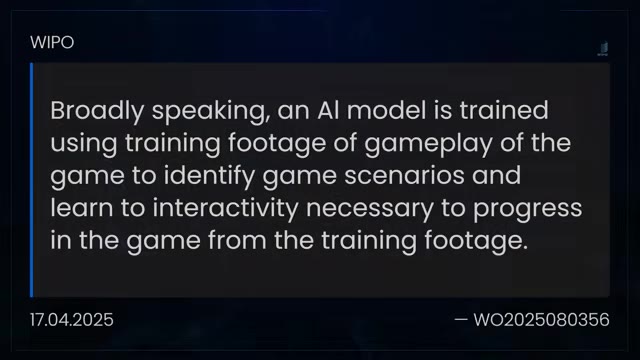
The AI model is trained by feeding it extensive gameplay footage to identify scenarios and learn the necessary interactivity to progress and succeed in the game, enabling it to replicate successful actions.
- 00:05:37
For Sony's first-party titles, developers would need to provide thousands of hours of gameplay footage to train the model before the game's launch, as scraping online content wouldn't be possible yet.
- 00:06:20
The complexity of this AI training is compared to Nvidia's ACE program, suggesting that Sony, with less GenAI experience than Nvidia, faces a significant challenge in developing such a system for their games before release.
Sony's Patent Hoarding Strategy
- 00:07:21
Sony submitted a patent for international searching despite criticism for its generic language and the technical ambiguity of 'ghost characters'.
- 00:07:58
A significant aspect of Sony's patenting strategy is 'patent hoarding,' where they acquire patents without necessarily implementing them.
- 00:08:09
Sony's vault contains numerous unused patents, including a 2009 patent for TVs to skip adverts by voice command, which was never implemented.
- 00:08:47
Holding patents allows Sony to prevent others from using similar technologies without paying a licensing fee, effectively controlling innovation until the patent expires.
Sony's Patent History and AI Exploitation
- 00:09:07
The discussion begins by referencing a previous instance where Ubisoft used fake players in a trailer, drawing a parallel to how Sony's AI patent could be used to assert legal claims if other companies develop similar AI teammates.
- 00:09:38
Patents are described as valuable assets, with examples from Nintendo, Sega, Konami, and Capcom, who use them to recover development costs by licensing out their patented mechanics.
- 00:10:03
The segment questions whether Sony's AI patent is a genuine attempt to enhance user experience or merely a strategic move to accumulate more patents, especially given the new frontier of AI in video games.
- 00:10:25
It is suggested that the promise of AI, rather than its actual implementation, might be sufficient to secure a patent, which can then be used for licensing and legal leverage, even if the technology isn't fully realized.
Moments
Sony's patent reveals an 'AI Ghost Player' for PlayStation. It includes a 'guide mode' that demonstrates level completion and a 'complete mode' that automatically finishes sequences. The feature improves accessibility by enabling the AI to take control when players struggle with input, akin to puzzle skips and ghost characters in other games.

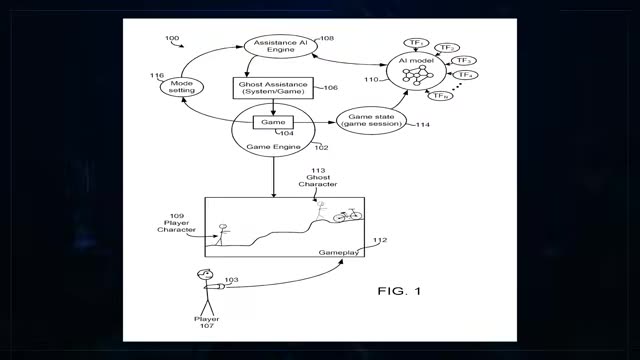
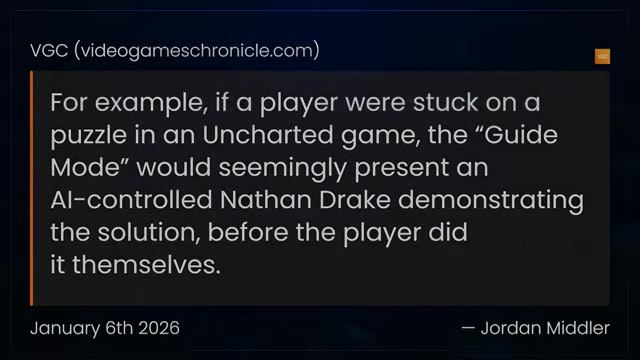
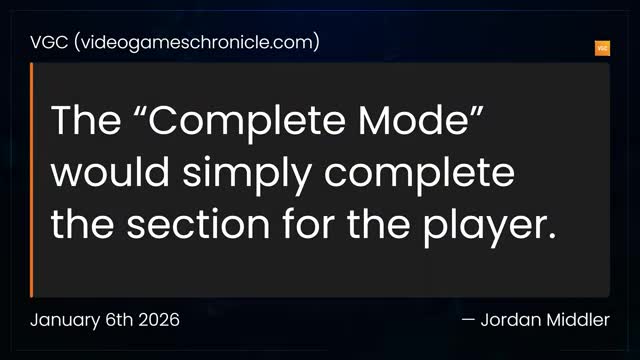
Sony's patented AI learns game environments and resources to make intelligent decisions, moving beyond pre-programmed paths. Training this AI demands extensive gameplay recordings before release, prompting speculation about Sony's generative AI capabilities relative to Nvidia.
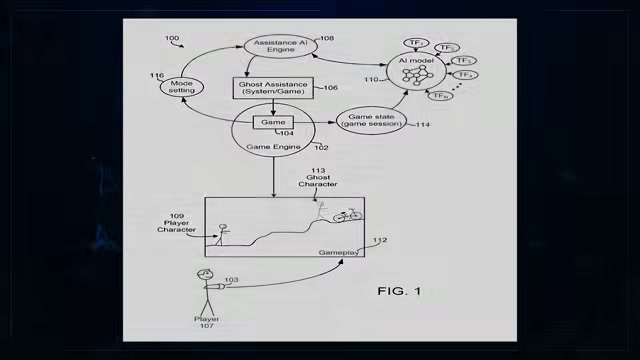
Sony's pursuit of this AI patent is likely a strategy for 'patent hoarding.' The company may be securing patents for future use or to prevent competitors from using similar technologies without licensing fees. This is a common practice among large corporations, as evidenced by Sony's history of holding numerous unimplemented patents.